Greetings! Welcome to the July edition of Dr. Pet Mom’s Delightful Pet Menagerie (DPM) Newsletter. The second week in July is National Farriers Week. This edition celebrates those special folks who take care of our pet horses. Farriers are the podiatrists of the horse world. Enjoy!
Back in the Saddle
One of my fun weekly activities is volunteering at a horse farm. I spend time with horses, their owners and the farriers. If you’ve never spent time around horses, give it a try.
Equinophobia is an intense fear of horses. People can be afraid of horses: they are big, strong animals with large hooves. We might think horses are hard to control.
But the cool thing about horses is that they can feel our emotions. When you feel calm, the horse will be calm. Control your feelings, and you will also control the horse.
Gentling is harnessing a powerful animal with understanding and nonverbal communication. Gentling is a very important way to relate to horses.
The last time I rode a horse, he reared up and bucked me off. So I was a little skittish before I met the horses at the farm.
But I read books about our human-horse connection. Horses are social prey animals and pick up on subtle emotional and physical cues. They recognize human facial expressions. Horses remember how people respond to them and adjust their behavior based on our emotions.
So I decided it was time to move forward and enjoy the experience of being around horses. And these days, the horses are my new BFFs, and we enjoy seeing each other.
The horse farm is for dressage riders. Dressage is all about the rider working in harmony with their horse. The sport highlights how your horse performs a set of prescribed movements for a panel of judges.
You can see the epitome of excellence in dressage riding at the Spanish Riding School. Watch any videos of the beautiful Lipizzan stallions to appreciate the skills of these wonderful horses and their riders.
Mike and Sean
I call Mike and Sean the horse farm’s dynamic duo. Horse owners talk to them before and after a ride, describe problems in their horse’s gait, improvements or other concerns.
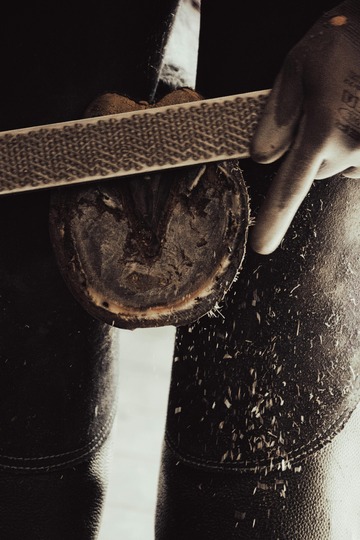
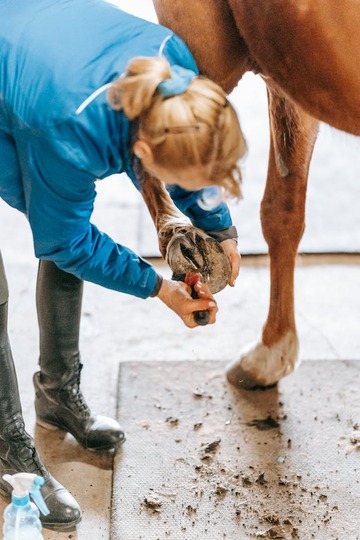
Mike is the seasoned farrier and Sean has worked with him for several years. The farriers offer advice on possible hoof problems and when a vet visit is needed. Educating horse owners is big part of their job.
I used to think that a gait was how we walk or run. But horses have a range of five natural gaits: walk, trot, canter, gallop, and back-up.
And some gaits are natural to the breed. Other gaits can be trained. Gait problems are very common.
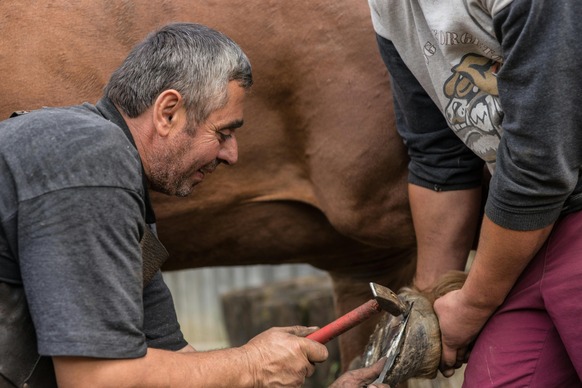
As a team, Mike and Sean work on fancy show horses (Warmbloods, Hanoverians), draft and cart horses (Clydesdales, Percherons, Shires), cows, goats, and pigs.
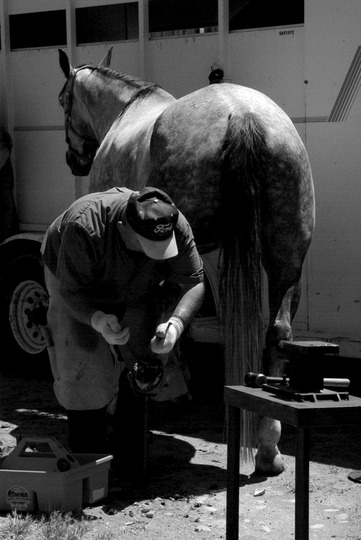
I take my hat off to these folks! Much of the farrier’s work is backbreaking and hard. The working position is usually bent over a horse hoof trimming, shoeing, or looking for signs of disease or gait problems.
Horses can be unruly. You need to be strong and steady working in an awkward position. You gotta love this work and love being around horses.
Safety and team work are big concerns among farriers: Only 32% of full-time farriers work alone when trimming or shoeing. Another 30% prefer not to work alone.

Horses Know Things
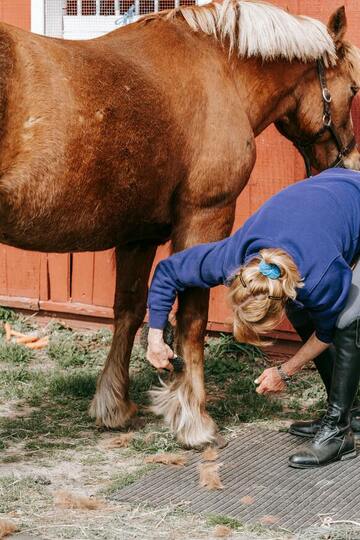
I ask if Mike and Sean if know any women farriers. I met one this winter as she trimmed hooves and put winter shoes on the horses.
Mike said he knows several women farriers. And their biggest advantage: Women are more patient.
Women farriers are skilled in gentling, using nonverbal communication to work with the horses. Strength and knowledge are important, but patience goes a long way.
Hanging around Mike and Sean helped me get back in the saddle. We talk about the personality of each horse, things to look out for, and how farriers help horses walk comfortably again. And we laugh about their farrier tales from the road.
The farriers notice that I always bring treats (apples, carrots, mints, sugar cubes). The horses know that I’m thinking about them.

Farrier Craftsmanship
Farriers are the unsung hero of the horse community. These equine podiatrists require skills in:
- Anatomy and physiology: Hooves are made of keratin, which is structurally dead tissue. In the hands of a skilled farrier, trimmed and shod horses experience no pain.
- Metallurgy and forging: Well-crafted and precise fitting horseshoes must match each horse’s hoof dynamics and the demands of its environment.
- Biomechanical analysis: Farriers must asses the balance, gait and limb alignment to enhance each horse’s movement.
- Emergency response: Farriers provide critical care for hoof injuries, abscesses, and lost shoes. Emergency care will keep horses comfortable and safe.
Yeah, all that and working with horse owners, veterinarians, farm managers and staff, trainers, breeders, farmers, and people who raise hoofed animals.
Formal certification is not required in the U.S. But a certificate from a trade association like the American Farriers Association (AFA) gives you a competitive advantage in the horse industry.
Experience with horses is very helpful and apprenticeship training is where real learning happens.
Snapshot of the Horse Industry
Here’s some 2025 stats about the horse industry:
- 7,200,000: Number of horses in the U.S.
- $122 billion: Annual contribution to the U.S. economy.
- $50 billion: GDP
- 988,394: Jobs (60% in managerial positions) and $38 billion in direct wages, salaries, and benefits.
- 1,370,000: Volunteers for horse-related activities annually.
- 1.6 million: Number of US households that own horses.
- $3,444: Average price of a riding horse.
- $7,896: Annual cost for a recreational horse.
- $100,000: Annual income of 50% of horse owners.
- 73%/27%: Percentage of male to female farriers.
This last statistic is interesting because most farriers are men. But more women are joining the profession.
For example, after 100 years in existence, the Cornell Farrier Program at the Cornell College of Veterinary Medicine admitted its first all-women class in 2018.
Closing Thoughts…
My work life is around a keyboard and computer – not the highlight of my week.
But the time I spend outdoors, doing manual labor, and being around horses, is like a breath of fresh air. Working in the heat, cold, smell, and dust of the farm is surprisingly fulfilling.
The folks on the horse farm and Mike and Sean are great company. Folks I would never have met if I didn’t volunteer to help animals.
If you give them a try, horses will make you happy. All that plus you’ll meet some great folks who love animals just like you!
Thanks for stopping by!
Dr. Pet Mom
“Let a horse whisper in your ear and breathe on your heart. You will never regret it.” ~~ Unknown
Every time I read Dr. Pet Mom’s Pet Menagerie Newsletter, I learn something new. I didn’t know what a farrier is, and what they do. Thanks for sharing this information, Dr. Pet Mom…very enlightening and informative. Horses are such beautiful and intelligent animals. I’ve always enjoyed being around them, although my experience is rather limited. Wonderful newsletter!