

Hello! Welcome to the October edition of Dr. Pet Mom’s Delightful Pet Menagerie (DPM) Newsletter. I love this time of year and hope your Fall season is a great one. This edition is an update for pet fish parents, and some fun fish facts. Enjoy!
Pet Fish Redux
In April, I wrote my DPM newsletter about caring for small exotic pets, including fish. If we think of fish as merely “ornamental” or throwaway pets, we forget that they are as complex and emotional as any large animal.
According to the 2025 report from American Pet Products Association (APPA), 11.1 million U.S. homes are pet fish households. Freshwater fish are #3 behind dogs (#1) and cats (#2) in popularity.
Fish are the most popular pets in the U.S. if you calculate popularity based on the number of owned pets. On average, pet fish owners care for around 10-12 fish.
While fish are sometimes viewed as simply “display animals”, we feel calm and relaxed just watching them.
Your pet fish need adequate stimulation in the form of an enriched environment. For example, research on fish intelligence revealed that fish have long-term memories, perform multiple complex tasks at the same time, and use tools.
So how can you keep your pet fish happy all year around? Design their home around fun activities, clean water, and buddies.
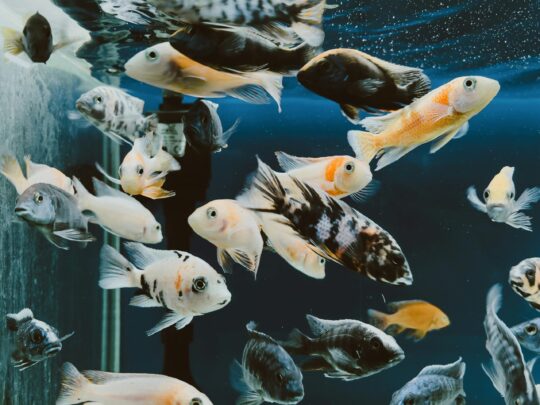
Let’s start with the basics.
Feeding: Proper food and how you feed your fish is very important. Some fish are scavengers and enjoy hunting for their food. Others enjoy sinking feeders, puzzle feeders or searching for live prey.
New friends: Introduce new fish into an existing tank slowly. Use hiding spots like a stack of rocks or a hiding toy. Hiding places can reduce stress during the quarantine period. And keep newborns separate from adults to prevent infanticide in the tank.
Happy home: Light in the fish tank is very important. Understand how artificial and natural light affect their daily cycle:
Gentle light supports natural behaviors and brighter colors in fish.
Direct sunlight can overheat the tank and promote algae growth.
Low light will stunt their growth and make your fish feel sluggish.
If you can, provide light with varying intensity and wavelengths to reflect seasonal changes.
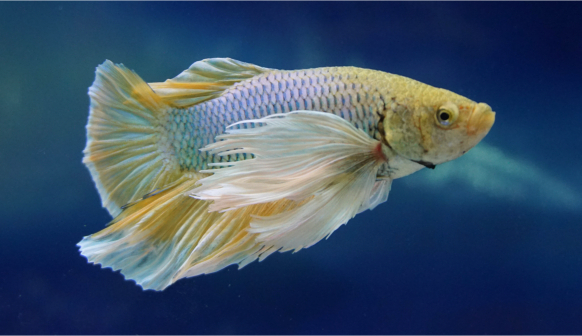
Five Freedoms
Do you know about the five freedoms for your pet fish?
Use these freedoms to keep your pet fish happy:
- Freedom from hunger.
- Freedom from fear and distress.
- Freedom from discomfort.
- Freedom from to express normal behavior.
- Freedom from pain, injury and disease.
While you will feed your fish daily, keep their living space interactive. You can find creative ways to change the furnishings in your tank each season. Keep your fish happy with new places to explore and hide.
Try target training with your fish. You can train them to come toward a fixed target such as a colored object or a light.
20 Fun Fish Facts
1. Most fish have taste buds all over their bodies. For example, the body of the Catfish is covered with more than 27,000 taste buds. Humans have around 7,000.
2. As a fish grows, it does not add new scales. The scales increase in size and these growth rings tell the age of a fish.
3. Fish need oxygen to live. They will suffocate and drown in water if there is not enough oxygen.
4. Most fish cannot swim backwards. Fish that swim backwards are a member of the Eel families or some type of Flatfish.
5. The fish in the middle of the school control the entire school. Fish on the outside are guided by fish in the middle. Only Bony fish can swim in highly coordinated groups.
6. While the Puffer fish is poisonous, it is a delicacy in Japan. The Stone fish is the most poisonous fish in the world. One sting can cause paralysis, shock, and death if not treated within a few hours.
7. The male Emperor Angelfish lives with up to five female mates. If the male dies, one of the females turns into a male fish and becomes the group leader.
8. The Anableps is a unique, four-eyed fish that can see above and below water at the same time.
9. Unlike many other fish, the Ocean sunfish does not have a tail. A female sunfish can lay 300 million eggs each year. Each egg is smaller than the period at the end of this sentence.
10. The world’s largest fish is the giant Whale shark which can grow to 60 feet long, or the length of two school buses. This fish is a plankton eater with over 4,000 teeth only 3mm long (.12 inches).
11. Seahorses have special features:
* Eyes that look backward and forward at the same time.
* Change colors to mimic their surroundings.
* Mate for life.
* The male holds the eggs in their pouch until they hatch.
12. The fastest fish is the Sailfish that can swim as fast as a car travels on the highway, with a recorded top speed of 68 mph.
13. The slowest fish is the Seahorse that can swim upright and slow enough to look like they’re barely moving. The Dwarf Seahorse is the slowest, traveling 5 feet in one hour.
14. Who needs the most water? Saltwater fish need to drink more water than freshwater fish. Seawater has more salt than the liquid in a fish’s body, and water inside the fish is constantly flowing out. If fish don’t replace the lost water, saltwater fish will dry up like prunes.
15. The deepest diving fish is the Anglerfish, diving as deep as 3,000 meters (about 2 miles). Its specialized body can withstand intense pressure of the deep ocean and a bioluminescence lure on its head is used to attract prey.
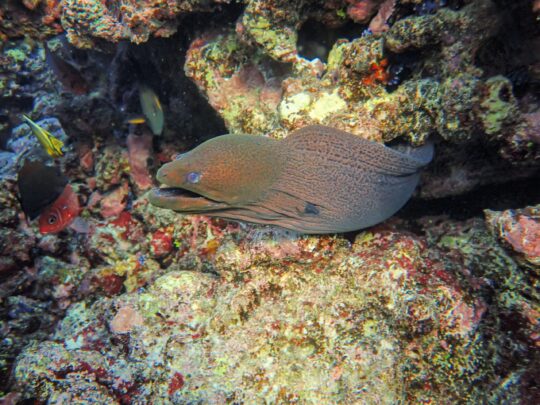
16. Longest migration. The Eel migrates up to 6,000 miles each year to reach its breeding grounds. Eel travel from the Sargasso Sea in the North Atlantic to freshwater rivers in Europe and North America where it was born.
17. Fish communication. Fish communicate using a variety of low-pitched sounds. They can moan, grunt, croak, boom, hiss, whistle, creak, shriek, and wail. Fish can rattle their bones and gnash their teeth. They do not have vocal chords and use body parts to make noises, like vibrating muscles against their swim bladder.
17. Largest school of fish. A school of Anchovies stretched over 20 miles off the coast of California. The school was large enough to be detected by satellite. The school was estimated to contain over 100 million individual fish.
18. Fish or fishes? The term “fish” refers to one species (10 guppies are 10 fish). But the term “fishes” applies to more than one species (10 catfish, 2 trout and 3 salmon are 15 fishes).
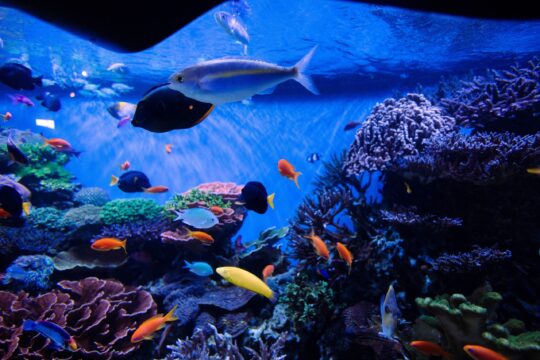
19. “Rain forests of the sea.” The coral reef is a complex ecosystem. This “rainforests of the sea” supports 25% of the ocean’s fish. Different species serve different roles in the ecosystem: Grouper are predators to monitor the population of other fish on the reef while Parrotfish eat algae to keep the coral healthy.
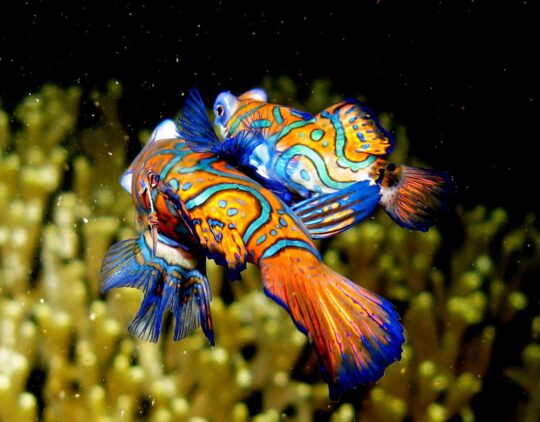
20. The most colorful fish in the world is the Mandarinfish. Its body is covered in orange and bright blue stripes and lives in the coral reefs of the Pacific Ocean. This colorful fish is popular with aquarium hobbyists.
Closing Thoughts…
I hope you enjoyed a pet fish refresher. And I hope you explore different ways to keep your pet fish happy!
Sources: 62 Fish Facts That Are Strange, Surprising, And Totally Real
30 Fun Facts About Fish That Are Amazing,
Thanks for stopping by!
Dr. Pet Mom
“No human being, however great, or powerful, was ever so free as a fish.”
~~John Rushkin